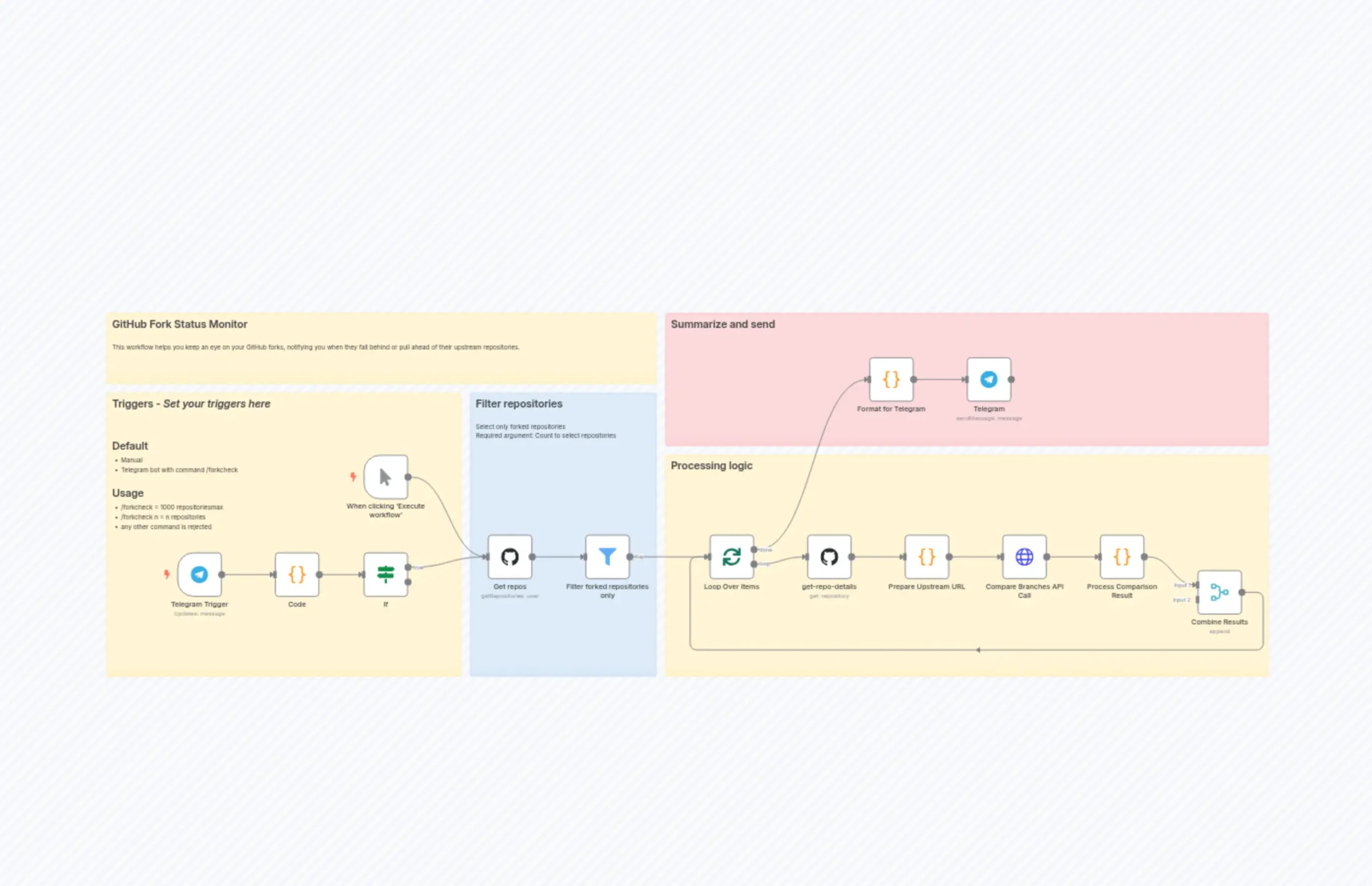
GitHub Fork Status Monitor
The GitHub Fork Status Monitor automatically tracks if your forked repository is synchronized with the original project. Effortlessly ensure your contributions are always based on the very latest codebase, preventing outdated work and enhancing productivity for all contributors.
49,00 €
What It Does
The GitHub Fork Status Monitor is an indispensable AI automation tool designed to eliminate the common pitfalls of working with forked repositories. It automatically and continuously tracks the synchronization status of your forked GitHub repositories against their original upstream projects. By proactively monitoring for new commits in the parent repository, it immediately identifies when your fork begins to fall behind. This ensures that every contribution you make is always based on the most current codebase, preventing developers from investing time into features that are built on outdated foundations. The monitor provides clear, actionable insights, enabling timely updates and seamless integration into the main project.
Key Features
- Automated Synchronization Tracking: Continuously monitors your forked repositories for divergence from their upstream counterparts.
- Proactive Out-of-Sync Alerts: Notifies you immediately when your fork is no longer up-to-date with the main project.
- Configurable Monitoring Thresholds: Set specific parameters, such as the number of commits behind, before an alert is triggered.
- Direct Upstream Change Links: Provides direct access to the specific commits or branches causing the fork to be out of sync.
Implementation
Setup Time: 10-15 minutes
Requirements: Active GitHub account, administrative access to your forked repositories, and authorization for the monitoring service.
Difficulty: Medium
Perfect For
- Open-Source Project Contributors: Individuals or teams contributing to community-driven projects, ensuring their work aligns with the latest master branch.
- Enterprise Development Teams: Organizations utilizing a fork-based Git workflow for feature development, bug fixes, or experimentation.
- Freelancers & Consultants: Professionals collaborating on client projects, needing to maintain strict sync with evolving client codebases.
Real-World Examples
Example 1: Streamlined Open-Source Contributions
An open-source developer contributes a new feature to a popular project. Without the monitor, they might work for three days on an outdated fork, leading to 4-5 hours of painful rebase and conflict resolution. With the monitor, they receive an alert after 15 new upstream commits, prompting a quick rebase early on and saving an estimated 3-4 hours of rework and frustration per feature.
Example 2: Enhanced Team Productivity in a Corporate Environment
A large development team of 50 engineers uses forks for their sprint tasks. Historically, 15-20% of their merge requests faced significant conflicts due to developers working on slightly stale forks. Implementing the monitor ensures forks are updated proactively, reducing merge conflict incidents by 35% and saving the team a collective 10-15 hours of developer time weekly on conflict resolution.
Why Choose This Tool
The GitHub Fork Status Monitor transforms a reactive problem into a proactive solution. Instead of discovering synchronization issues during time-consuming merge requests, this tool provides early warnings, empowering developers to maintain an always up-to-date codebase. It significantly reduces wasted effort, minimizes costly merge conflicts, and accelerates development cycles. By ensuring that every contribution is built on the latest foundation, your team gains efficiency, saves valuable development hours, and enhances the overall quality and reliability of your software projects.
Specification: GitHub Fork Status Monitor
|
User Reviews
Be the first to review “GitHub Fork Status Monitor”
You must be logged in to post a review.
Related Products




There are no reviews yet.